
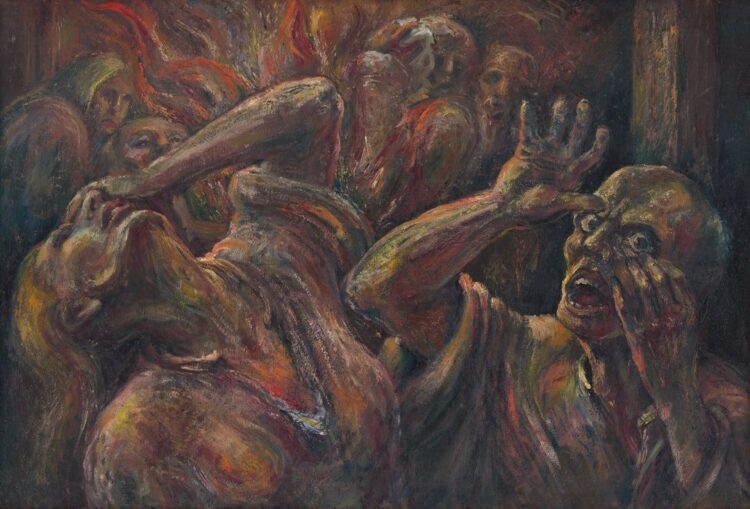
Beyond Horror: The Intentional Fracturing of the Human Form
The distorted figure can look like an assault on anatomy, but its deepest purpose is rarely anatomical destruction. In serious figurative painting, deformation is a form of measurement. A shoulder sinks because ordinary posture cannot contain grief. A face melts because recognizable identity has become unstable. Limbs lengthen, torsos buckle, and flesh appears to smear across the picture plane because the painter is translating an interior condition into visible structure. For readers drawn to experimental figurative art, the grotesque is therefore less a spectacle of horror than a disciplined method of inquiry.
After the Second World War, many artists found the inherited language of classical realism inadequate to the psychological atmosphere around them. The ideal body, proportioned according to Renaissance harmony, seemed unable to register extermination, nuclear fear, political violence, displacement, and the private aftermath of mass death. The body had become historically charged. It was no longer simply a vessel of beauty or a stable coordinate system; it was vulnerable matter, exposed to machinery, institutions, illness, desire, and time.
This is why postwar distortion should not be confused with crude caricature or random provocation. It is a somatic vocabulary for interiority. By fracturing the visible body, painters make psychic damage legible without reducing it to illustration. The broken form does not evade truth. It intensifies truth, turning physical deformation into a forensic instrument for examining vulnerability, alienation, and the stubborn persistence of human presence.
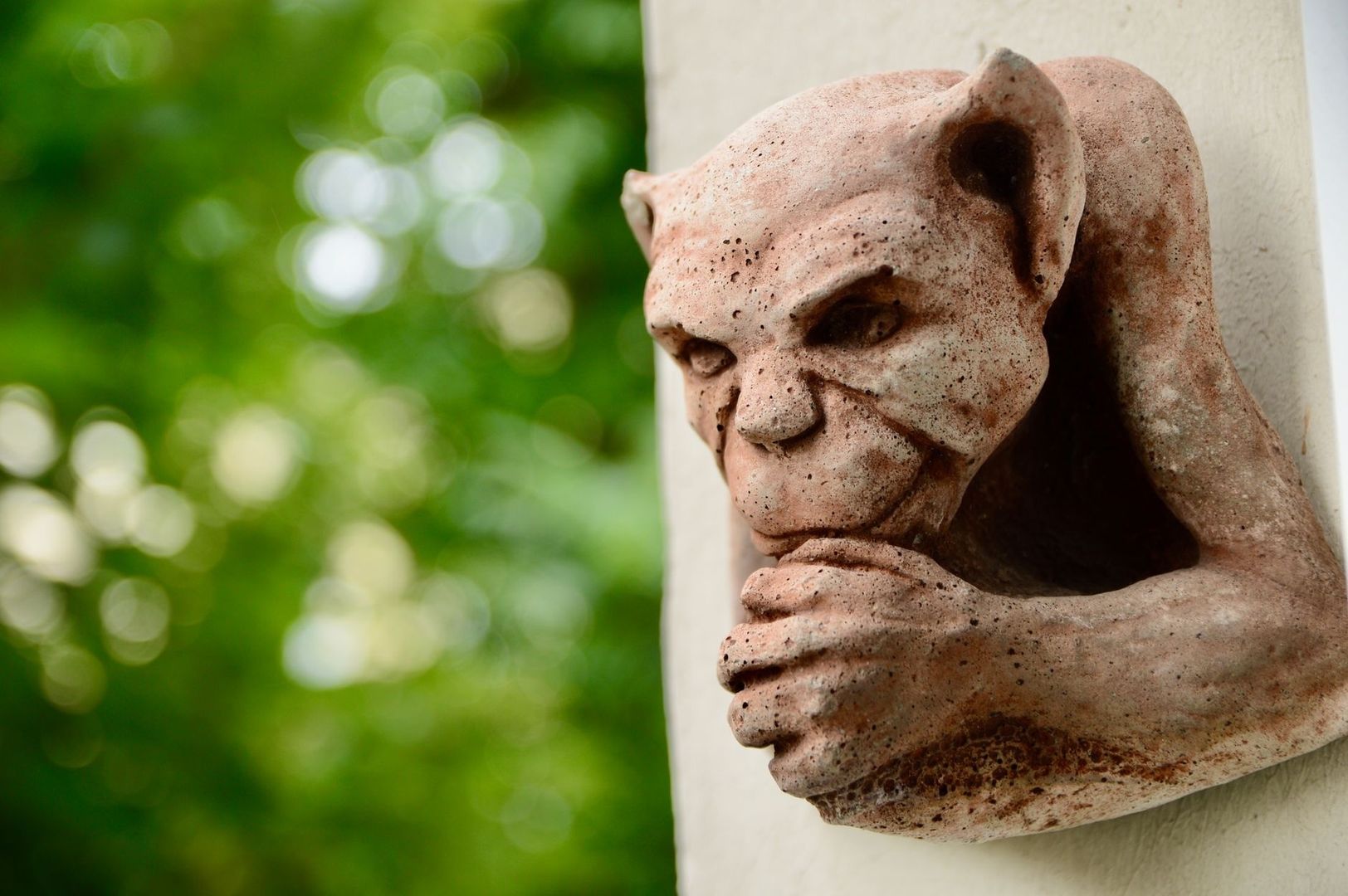
The Mechanics of Postwar Disruption
British figurative painting between 1945 and 1965 developed under conditions that made bodily stability feel morally and historically suspect. The period was marked by wartime destruction, the emergence of nuclear anxiety, decolonization, migration, and shifting ideas of liberty and equality. The exhibition Postwar Modern situated these developments across roughly 200 works by 48 artists, showing how abstraction and figuration often operated within the same atmosphere of rupture rather than as neatly opposed camps.
In this context, the move away from anatomical fidelity was not a rejection of skill. It was a redefinition of what skill had to accomplish. Classical realism organizes the body through proportion, contour, weight, and coherent spatial placement. Postwar disruption interferes with those systems while retaining enough structural knowledge for the interference to remain intelligible. The viewer still recognizes a head, a rib cage, a hand, or a seated figure, but recognition arrives under pressure. The body is present and impossible at once.
| Classical figurative fidelity | Grotesque postwar disruption |
|---|---|
| Proportion establishes harmony | Disproportion establishes psychological tension |
| Contour separates body from space | Contour breaks down, allowing flesh and space to contaminate each other |
| Pose communicates stable identity | Pose suggests instability, isolation, or psychic collapse |
| Depth creates a believable world | Flattened or hostile space creates existential confinement |
Francis Bacon became the most forceful emblem of this transformation, but he was part of a wider field that included Frank Auerbach, Leon Kossoff, Francis Newton Souza, Lynn Chadwick, Jean Cooke, and others. Their approaches differed, yet many treated the body as a site where history became tactile. Thick paint, scraped surfaces, compressed interiors, and scarred contours made the image feel less like a window than a surface under stress. Distortion became a means of showing that the postwar subject could no longer be represented as untouched.
Francis Bacon and the Architecture of Meat
Bacon”s figures are often described as screaming, twisted, or deformed, but those words can obscure the precision of his construction. A typical Bacon painting does not dissolve into undirected chaos. Instead, the figure is placed within a controlled system of contrasts: a raw, unstable body against a flat ground; organic flesh against hard geometric framing; a violently activated mouth against an almost silent field of color. The transparent cage, oval, rectangle, or linear armature does not merely imprison the subject. It gives distortion a measurable architecture.
His paint handling begins with recognizable information and then subjects it to disruption. Bacon smeared passages laterally, dragged pigment across contours, wiped away features, and reasserted selected edges. A face might retain the dark socket of an eye while the rest of its structure is pulled sideways. A torso can be modeled enough to imply weight, then abruptly flattened into a stain. The result is not an anatomy lesson but a collision between bodily evidence and pictorial violence.
Photography and printed imagery supplied crucial launchpads for this process. Research into the material preserved in Bacon”s Reece Mews studio identified photographic sources for 369 of 584 catalogued paintings, according to Katharina Günther”s study of Bacon and photography. These materials included photographs, magazines, medical illustrations, books, and clippings. Bacon did not simply reproduce them. He combined fragments, cut and folded images, ignored original identities, and treated damage, stains, and disintegration as productive visual conditions.
- Smearing converts the body from a stable object into an event unfolding across the canvas.
- Contortion preserves the body”s recognizability while making its psychological condition impossible to ignore.
- Geometric isolation turns space into an instrument of confinement, separating the figure from ordinary social reality.
- Selective reconstruction demonstrates that distortion depends on anatomical knowledge, because the painter must know which structures can be displaced without destroying recognition.
This distinction separates Bacon from caricature. Caricature usually amplifies a socially legible feature, such as a nose, jaw, posture, or expression, in order to sharpen identity or satire. Bacon”s displacements operate more fundamentally. They challenge the stability of identity itself. In works such as Three Studies for Figures at the Base of a Crucifixion from 1944, the screaming, animal-like forms redirect religious imagery toward secular suffering and the exposed brutality of modern existence. The body is not exaggerated to make a person more amusing or more recognizable. It is transformed to show what ordinary appearance conceals.
Perceptual Fault Lines and Somatic Disquiet
Distorted bodies unsettle the viewer because they interrupt the brain”s ordinary negotiations with scale, balance, and identity. An elongated limb may remain technically readable, yet its length contradicts the body”s expected mechanics. A melting face preserves enough facial organization to invite recognition, while simultaneously withholding the stable features through which recognition normally occurs. The eye keeps trying to repair the image, and the painting keeps refusing repair.
This experience has intriguing parallels with perceptual conditions such as Alice in Wonderland syndrome, or AIWS, in which familiar objects can appear altered in size, movement, facial appearance, or spatial relation while retaining their general identity. A 2024 study in Frontiers in Psychiatry examined whether contemporary figurative painters might represent experiences resembling such perceptual distortions. Among 20 interviewed painters, 85 percent reported some positive perceptual disorder and 55 percent reported metamorphopsias, although most did not knowingly reproduce their own specific experiences in their work.
The significance of this research is not that every distorted painting should be diagnosed as a visual symptom. That would flatten artistic intention into pathology. Rather, it clarifies why dislocated realism can feel so psychologically immediate. The viewer recognizes the world”s basic elements but encounters them under altered conditions, producing a form of embodied uncertainty. Emotional response also depends on more than facial expression. Research on visual emotion emphasizes that meaning is subjective, multidimensional, and shaped by arousal, appraisal, movement, color, and context, as discussed in this overview of emotion in visual media.
- Warped scale makes the body feel vulnerable to forces it cannot control.
- Elongated limbs turn reach, escape, and contact into unstable possibilities.
- Compressed torsos suggest pressure, suffocation, or the collapse of personal space.
- Melting features produce a perceptual mirror in which viewers confront their own fear of losing identity.
This mirror response helps explain why the grotesque can generate empathy rather than simple revulsion. The viewer does not only see a body made strange. The viewer feels the precariousness of having a body at all. Distortion transfers vulnerability from the painted subject to the act of looking, making perception itself feel temporary, exposed, and subject to fracture.
Contemporary Continuations from Louise Bonnet to Identity Subversion
Contemporary painters extend this language into a culture dominated by digital polish, biometric tracking, image circulation, and relentless self-presentation. The ideal body now arrives through filters, cosmetic interfaces, fitness metrics, advertising algorithms, and platforms that reward immediate legibility. Against this pressure, bodily excess becomes a refusal to appear optimized. Exaggerated limbs, swollen extremities, collapsed faces, and surreal volumes make the body too strange to be efficiently consumed as a beauty image.
Louise Bonnet”s paintings offer a particularly vivid example of how awkward volume can become both comic and unsettling. In Scotch Tape, an oil painting from 2016, the figure”s exaggerated bodily presence turns ordinary vulnerability into an unstable visual fact. The work”s market reception, including a sale for HK$1,397,000, indicates that grotesque figuration is not marginal to contemporary art discourse. Its excess can function as a sophisticated vehicle for examining discomfort, self-consciousness, desire, and the social pressure to maintain a coherent exterior.
- Expose the norm. Begin by identifying the bodily ideal being enforced, whether it is slenderness, symmetry, gender legibility, youth, or digital smoothness. The grotesque becomes effective when its deformation reveals the rule it violates.
- Expand the body beyond containment. Enlarged hands, bloated feet, extended necks, or impossible torsos can make identity physically excessive. The point is not simply to make the figure ugly, but to give suppressed experience a material scale.
- Return authorship to the subject. In trans and gender-nonconforming practices, bodily excess can operate as endurance, revolt, revelation, and self-authored transformation. As discussed by Flash Art”s account of the grotesque, hybrid and distorted forms challenge the cultural demand that bodies remain coherent, contained, and easily categorized.
This contemporary turn also complicates the presumed boundary between painterly distortion and identity politics. Artists working with performance, photography, digital manipulation, and hybrid media use bodily rupture to expose the institutional machinery behind normalcy. The grotesque does not simply depict an outsider body. It shows how bodies become labeled, monitored, disciplined, and made legible. Its strange volumes are therefore conceptual as well as visual: they disrupt the systems that decide which forms deserve recognition.
Reading the Unbroken Truth of Broken Forms
Distortion is not an escape from truth but a heightened method of reaching it. The successful grotesque figure is built through decisions about structure, pressure, color, edge, scale, and omission. Its apparent instability depends on underlying control. When a painter displaces anatomy with conviction, the result can reveal emotional facts that descriptive accuracy would leave untouched: grief as collapse, fear as constriction, desire as enlargement, or identity as a body refusing fixed boundaries.
Approach such work by asking what has been displaced, what remains recognizable, and how the surrounding space reinforces the figure”s condition. Notice whether the distortion advances the composition or merely seeks shock. Then allow the image to produce its own perceptual difficulty. The twisted figure asks for more than tolerance of ugliness. It asks for attention to craft, historical pressure, and the vulnerable intelligence of the body. In that encounter, broken forms become more than images of damage. They become instruments of recognition.