
Beyond Pathology and the Cloistered Creative Mind
Absolute seclusion is often read too quickly as evidence of dysfunction. In discussions of visionary outsider art, withdrawal is routinely reduced to diagnosis, biography, or social failure, as though the work were merely an involuntary symptom made visible. A broader research discussion of isolation and mental health is available through Checking your browser. That interpretation misses the architecture of the practice. For some creators, isolation becomes an incubator: a sealed environment in which perception can intensify, private symbols can accumulate, and visual decisions can develop without the corrective pressure of ordinary social exchange.
This does not mean that suffering, institutionalization, poverty, or coercion should be romanticized. Involuntary confinement can be devastating, and the lives of outsider artists must not be flattened into inspirational myths. Yet the work itself demands a more exact account. When commercial compromise, market trends, academic dogma, and the desire to satisfy an audience are removed, another kind of discipline can emerge. The artist is no longer negotiating with a recognizable style or an anticipated buyer. Each mark answers primarily to the internal demands of the image.
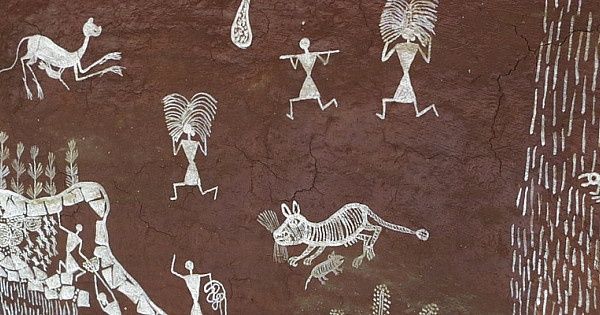
The result may be a self-contained visual mythology, complete with recurring figures, invented alphabets, sacred geometries, cosmological hierarchies, and narrative systems that cannot be translated into a single explanatory key. Such worlds are not always planned in advance. They are built through compulsive necessity, one page or object at a time. Their coherence comes less from public convention than from sustained attention. Seclusion, in this sense, acts like an architectural kiln: it removes distractions, concentrates heat, and hardens an otherwise fragile imaginative structure.
Solitude as Laboratory and the Archetype of Creative Withdrawal
Across religious and cultural history, solitude has been used as a technology of perception. Hermits, anchorites, anchoresses, monastics, contemplatives, and recluses have withdrawn from ordinary social rhythms to sharpen prayer, thought, or spiritual discernment. The historical record is not uniformly benign, and cultural representations have often treated isolated women more harshly than isolated men. Still, the recurring pattern is clear: being alone and feeling lonely are not identical conditions. As the BBC explains in what hermits can teach us about isolation, solitude can be restorative, structured, and conducive to self-knowledge when it is supported by purpose and routine.
Outsider artists inherit this archetype without necessarily sharing its religious framework. The studio, hospital room, domestic interior, or improvised workspace can become a laboratory in which external validation gradually loses authority. Once there is no immediate audience to impress, the imagination may stop translating itself into familiar forms. A face can become a mask, a domestic object can become a ritual instrument, and a repeated line can turn into a boundary between visible and invisible orders.
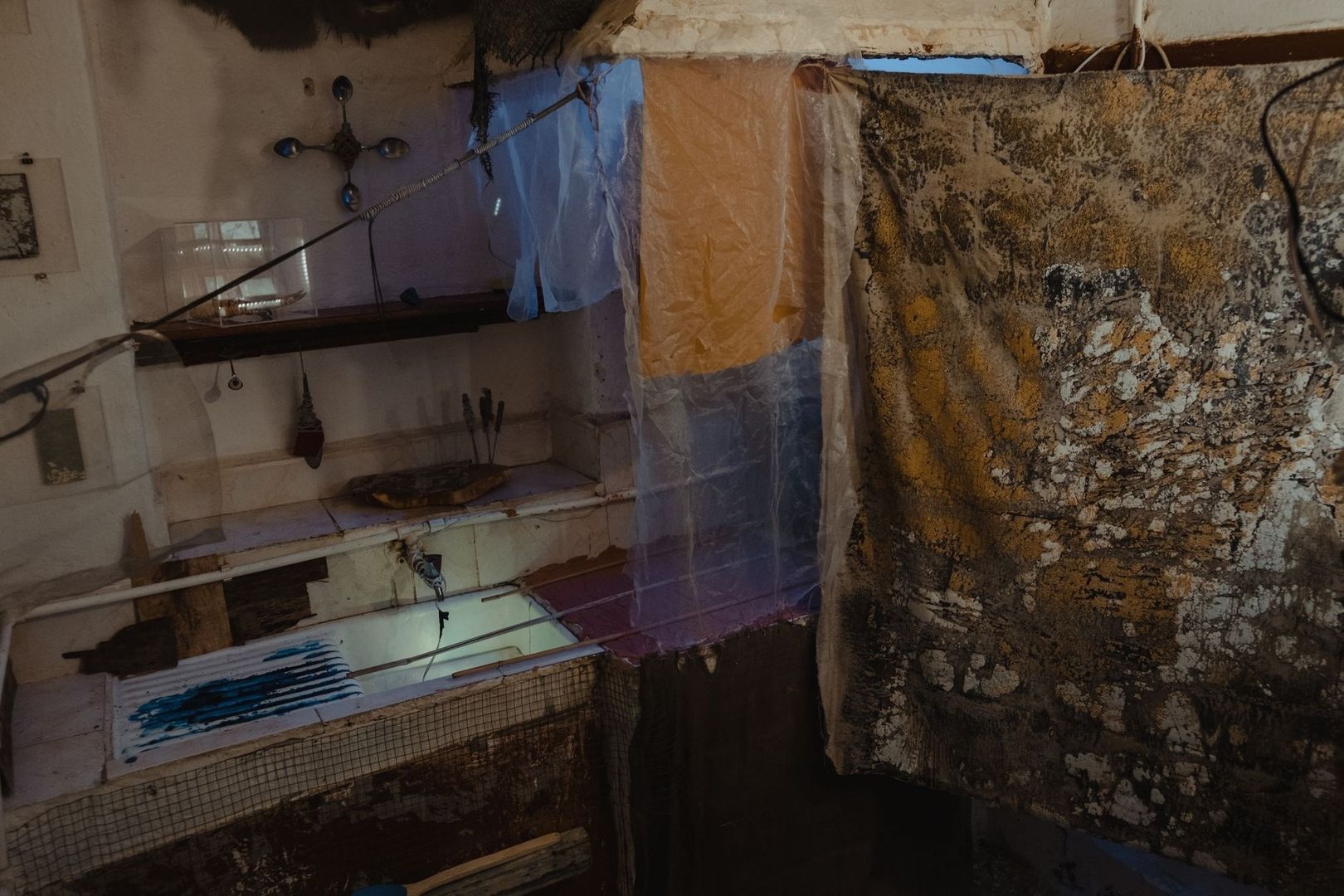
The essential distinction is between involuntary confinement and active, generative internal sheltering. The two may coexist, particularly in the lives of artists affected by institutional restrictions, illness, poverty, or social exclusion, but they should not be treated as interchangeable. Productive solitude requires some form of agency, even if that agency is limited to choosing a material, repeating a gesture, or deciding what image must be made next.
- Withdrawal removes the demand to perform an acceptable identity for others.
- Routine converts unstructured time into a dependable creative container.
- Repetition gives attention a tactile anchor when language or social interaction becomes unstable.
- Symbolic invention permits experiences to be organized without submitting them to conventional explanation.
Anatomy of an Insular Cosmology
A complete visionary world is not simply a collection of strange images. It has architecture. Aloïse Corbaz, for example, developed an intensely personal universe populated by theatrical figures, erotic charge, color, costume, and historical fantasy. Augustin Lesage produced vast, symmetrical compositions whose architectural density suggests temples, palaces, diagrams, and unseen orders. Their works differ substantially, yet both demonstrate how a private cosmology can become legible through recurring formal principles rather than through academic training.
The Art Brut collection in Switzerland places artists such as Corbaz and Lesage alongside Marguerite Sirvins and Auguste Walla, describing works made outside established artistic traditions and trends. This framing is useful when handled carefully. “Outside” does not mean careless, primitive, or technically empty. It can mean that the work”s rules were generated internally rather than inherited from a school, movement, or professional network. The artist may reject conventional perspective while maintaining extraordinary control over symmetry, density, proportion, color, or symbolic recurrence.
| Insular worldbuilding | Institutional academic art |
|---|---|
| Rules emerge through sustained personal practice | Rules are transmitted through schools, histories, and critique |
| Symbols acquire meaning through recurrence and private association | Symbols often operate within shared cultural or art-historical codes |
| Composition may prioritize psychic or ritual necessity | Composition is frequently evaluated through recognized formal standards |
| Audience interpretation is secondary to the imperative to make | Audience, criticism, and professional context often shape production |
Within these worlds, a pantheon can be established without a written mythology. A particular woman, animal, architectural form, or geometric sign may return across dozens of works, each appearance adding a new layer of authority. Repetition turns an isolated motif into a character, then into an emblem, and eventually into a law of the universe. The same process can produce sacred alphabets, directional codes, invented calendars, or visual borders that separate ordinary space from consecrated space.
The Ritual Mechanics of Repetition and Material Resourcefulness
Repetition is one of the most visible engines of outsider practice. Dense mark-making, horror vacui, geometric precision, and serial figures can look obsessive from the outside, but their function is more complex than an easy psychological label suggests. A repeated stroke establishes rhythm. A filled surface suppresses uncertainty. A symmetrical structure creates a temporary world in which every edge, interval, and counterform has a role. The image becomes both record and instrument, preserving attention by giving it a sequence of physical tasks.
Material resourcefulness intensifies this ritual quality. Artists working beyond institutional support may use salvaged paper, cardboard, packaging, fabric, industrial remnants, household objects, or pigments of uncertain origin. These materials are not merely substitutes for proper art supplies. Their scars, folds, stains, and previous uses become part of the visual language. A discarded surface carries an outside history, then enters a new system through cutting, layering, staining, stitching, or inscription. Utility and symbolism can occupy the same object, as demonstrated by the broad range of works discussed in the American Folk Art Museum”s Folk Art Revealed, where household forms, personal memory, community identity, and spiritual practice frequently overlap.
Claims about clinical or neurological drivers require particular caution. In psychological and aesthetic analysis, repetitive tactile activity is often recognized as a stabilizing mechanism that helps anchor attention, provide sensorimotor regulation, and manage cognitive overload. However, these grounding behaviors should not be misread as diagnostic symptoms that explain away the artwork. Sustained, rhythmic tasks provide vital cognitive and formal structure during periods of deep isolation, while the expressive meaning of the resulting images remains an artistic, biographical, and inventive achievement. A recurring pattern is neither simple pathology nor automatic transcendence; it is a chosen architecture of practice.
- Choose a constraint. Limit the palette, format, gesture, or available material so that attention can deepen instead of scattering.
- Establish a repeatable action. Use stitching, hatching, stamping, coiling, mapping, or another tactile procedure that can continue without constant conceptual decisions.
- Track deviations. Notice where the pattern breaks, expands, darkens, or changes scale. These departures often reveal the emerging internal logic.
- Allow the system to become symbolic. Do not force an interpretation too early. Let recurring forms acquire meaning through use.
When evaluating the limits of clinical explanations, scholars and critics must maintain this discipline of restraint. While psychological research broadly demonstrates that structured manual work can mitigate isolation-induced stress, attempting to map complex visionary systems directly onto clinical diagnostic models strips the maker of creative intentionality. Rigorous writing about visionary art demands distinguishing empirical behavioral observations from speculative psychiatric labels, ensuring that visual ingenuity is never collapsed into an involuntary symptom.
Unfiltered Lexicons and the Freedom from the Marketplace Gaze
The marketplace gaze is powerful because it arrives before the work is finished. Artists learn to anticipate what will photograph well, what can be explained in a press release, what fits a collector”s wall, and what resembles a current trend without appearing derivative. Absolute seclusion can interrupt that anticipatory loop. Without a gallery deadline, critique cycle, or sales conversation, an image may become excessive, awkward, intimate, or formally inconvenient. It can take the long route toward its own necessity.
Roger Cardinal”s account of outsider art emphasizes urgent self-expression, imaginative departures, and the enduring relationship between maker and object. Jean Dubuffet”s concept of Art Brut similarly sought creative activity that had not been fully assimilated into established art culture. Neither position should be treated as a guarantee of purity. The moment a museum, collector, or scholar names an artist “outsider,” the work enters a new institutional frame. Yet the category remains valuable when it directs attention toward self-generated languages rather than toward conformity with academic credentials.
- It challenges the assumption that technical legitimacy must begin with formal schooling.
- It exposes how often “good taste” is shaped by market circulation.
- It expands the definition of composition to include accumulation, ritual, inventory, and obsession.
- It asks institutions to encounter unfamiliar visual systems without immediately domesticating them.
The strongest outsider work is therefore not valuable because it is untouched by culture. No artist is outside history entirely. Its force lies in the way cultural material is reassembled under private pressure. Familiar signs become strange; ordinary materials become charged; decorative excess becomes cosmological structure. The result is not an escape from art history but a challenge to who is permitted to write its rules.
Reclaiming the Sacred Perimeter of Independent Creation
Seclusion can function as architectural scaffolding for a visionary universe. It supplies the enclosure in which attention becomes durable, repetition becomes method, and private symbols become a coherent lexicon. The most compelling works born from isolation do not merely document loneliness. They construct an alternative order, one with its own borders, inhabitants, ceremonies, and laws. Their strangeness is often the visible trace of a sustained refusal to simplify inner experience for public convenience.
Modern creators need not imitate total withdrawal to recover this power. Establish protected periods without metrics, audience feedback, or market research. Work with a deliberately restricted material vocabulary. Keep a symbol or gesture in circulation long enough to discover what it can become. Most importantly, resist the demand to explain every unusual decision before the work has acquired its full density. In a hyper-connected era, independent creation requires a sacred perimeter: not a romantic prison, but a deliberate zone in which an image can become answerable first to its own internal necessity.