
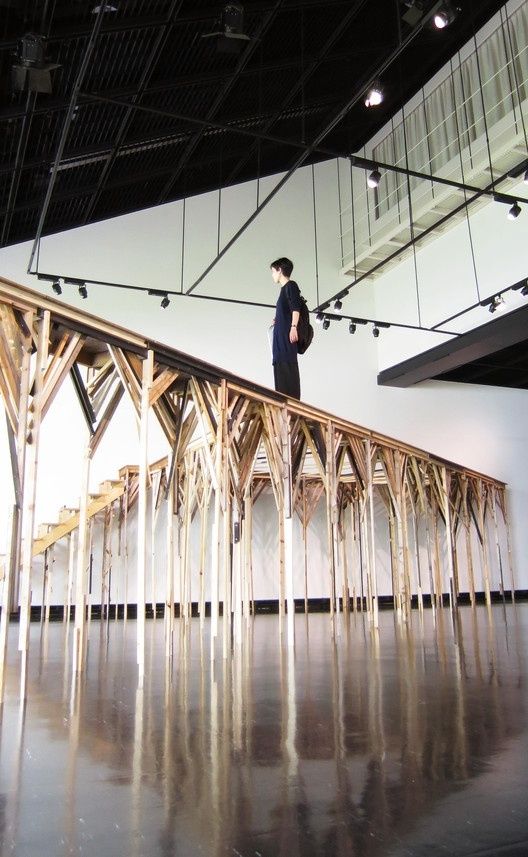
Stepping Across the Frame into Boundless Space
The traditional white cube promises neutrality, but its blankness is never truly innocent. Sealed walls, controlled illumination, polished floors, and disciplined sightlines establish a behavioral contract: stand at a measured distance, remain quiet, and contemplate the autonomous object. The gallery visitor becomes an eye detached from the body, a supposedly disembodied intelligence moving through a sequence of framed propositions. This model has enabled extraordinary forms of visual concentration, yet it also conceals the architectural conditions that make concentration possible.
A walk-in total environment breaks that contract. It does not simply place more objects in a room; it treats the room itself as an active medium, combining structure, light, sound, movement, texture, scale, and circulation. The viewer no longer approaches a finished image from the outside. Instead, the viewer crosses a threshold and enters a work whose meaning changes according to bodily position, duration, orientation, and proximity. The historical tension is therefore not merely between old and new exhibition design. It is between detached contemplation and embodied immersion, between art as an object before the spectator and art as a spatial event that requires the spectator to complete it.
The Proto-Architectural Shift of Schwitters and Merzbau
Kurt Schwitters”s Merzbau remains one of the decisive precedents for total environments because it transformed accumulation into habitation. What began within domestic living quarters in Hannover developed into an expanding, irregular construct of planes, cavities, projections, objects, and materials. Schwitters did not treat the home as a neutral container for sculpture. He progressively re-authored its rooms, allowing the architecture to become an evolving composition. The result was neither conventional collage nor conventional building, but a porous hybrid in which everyday life, private memory, and formal invention became inseparable.
The shift from assemblage on canvas to habitable spatial architecture altered the status of the fragment. On a canvas, a ticket stub, scrap of wood, or industrial remnant is fixed within a bounded field. In the Merzbau, the fragment participates in an environment that can be entered, navigated, and experienced from multiple angles. A wall can become a relief; a niche can operate as a container of memory; a passage can compress the body and alter the tempo of looking. This is the proto-architectural force of the work: composition becomes something through which a person must physically move.
The original Hannover Merzbau no longer exists. It was destroyed in an air raid in 1943, and its history now includes a complex chain of photographs, plans, recollections, and reconstructions. Peter Bissegger reconstructed the principal room between 1981 and 1983, drawing on three photographs from 1933, incomplete plans, geometric calculations, and memories recorded from Schwitters”s son Ernst. The reconstructed work, permanently installed at the Sprengel Museum Hannover, demonstrates both the power and the uncertainty of reconstructive installation. As Tate”s account of the Merzbau makes clear, visitors may confuse reconstructed elements with original material, a problem that is especially acute when the artwork”s identity depends on its spatial continuity.
- From surface to enclosure: fragments leave the pictorial plane and become spatial obstacles, thresholds, and containers.
- From viewing to navigation: meaning develops through routes, pauses, obstructions, and changing bodily perspectives.
- From object to system: each component gains force through its relation to the total environment rather than through isolated display.
The body is therefore not merely a visitor to the Merzbau. It is one of the work”s structural conditions. Shoulders register narrowness, eyes adjust to irregular surfaces, and feet negotiate a space that resists the predictable logic of architectural circulation. The environment produces a subtle reversal: the viewer appears to enter the artwork, yet the artwork also enters the viewer through proprioception, memory, and altered expectations of domestic space.
Spatial Sensory Strategies in the Modern Installation
Modern immersive installation extends Schwitters”s architectural logic through deliberate manipulation of sensory thresholds. Walls may become permeable screens, ceilings may dissolve into projected skies, and floors may refuse to behave as stable visual foundations. Cristina Iglesias”s constructed passageways, latticed panels, mazes, suspended pavilions, and text-imbued walls are particularly instructive because they complicate the boundary between interior and exterior. Industrial structures can resemble vegetation, while organic forms can appear engineered. Her environments make architecture feel overgrown, provisional, and cognitively unstable.
Immersion is not produced by scale alone. A large room can remain psychologically distant if its surfaces are passive, while a small enclosure can become total if it controls light, sound, reflection, and movement with precision. Historically, immersive art has combined optical technology and theatrical staging, from the magic lantern and the phantasmagoria to the panorama and later projected environments. Contemporary practice inherits this ambition but replaces the promise of a seamless illusion with a more complicated awareness of mediation. The visitor is absorbed and reminded of absorption at the same time.
When evaluating how immersive installations recalibrate cognitive thresholds, academic research on immersive art and perception is useful because it distinguishes reflective multisensory experience from spectacle designed only for rapid consumption. The distinction matters. Immersion can deepen attention, encourage spatial reflection, and create shared experience, but it can also reduce an ambitious work to a photogenic backdrop if the sensory apparatus overwhelms its conceptual structure.
| Spatial tactic | Primary effect | Change in bodily orientation |
|---|---|---|
| Scale distortion | Makes the body feel miniature, enlarged, or proportionally uncertain | Weakens ordinary judgment of distance and volume |
| Controlled illumination | Separates visible surfaces from surrounding darkness | Redirects attention and destabilizes peripheral awareness |
| Reflection | Duplicates the body and environment | Confuses the distinction between observer and observed |
| Acoustic containment | Creates echo, absorption, rhythm, or directional sound | Turns hearing into a tool for mapping invisible boundaries |
| Textural thresholds | Introduces resistance, softness, friction, or tactile suggestion | Links interpretation to balance, pace, and physical caution |
These tactics reconfigure perception because orientation is never purely visual. A corridor that narrows while its projected image expands produces conflicting signals about movement and size. A dark room with a highly illuminated center can make the surrounding body feel absent, even while the feet continue to measure the floor. Sound may seem to come from an architectural surface, turning a wall into an acoustic event rather than a boundary. The strongest total environments do not simply stimulate every sense; they set the senses against one another, forcing the visitor to negotiate discrepancies.
Mirrored Infinity and the Disorienting Collapse of Perspective
Yayoi Kusama”s Infinity Mirror Rooms make the logic of total environment unusually legible. Mirrored walls multiply lights, bodies, and architectural edges until the room appears to extend beyond its physical dimensions. Visual distance is not expanded in a conventional perspectival manner; it is repeatedly folded back upon itself. The eye searches for a stable horizon and finds only recursive depth. In works such as Infinity Mirrored Room – Filled with the Brilliance of Life and Chandelier of Grief, reflection becomes an engine of spatial production, generating an apparently boundless universe from a tightly controlled enclosure.
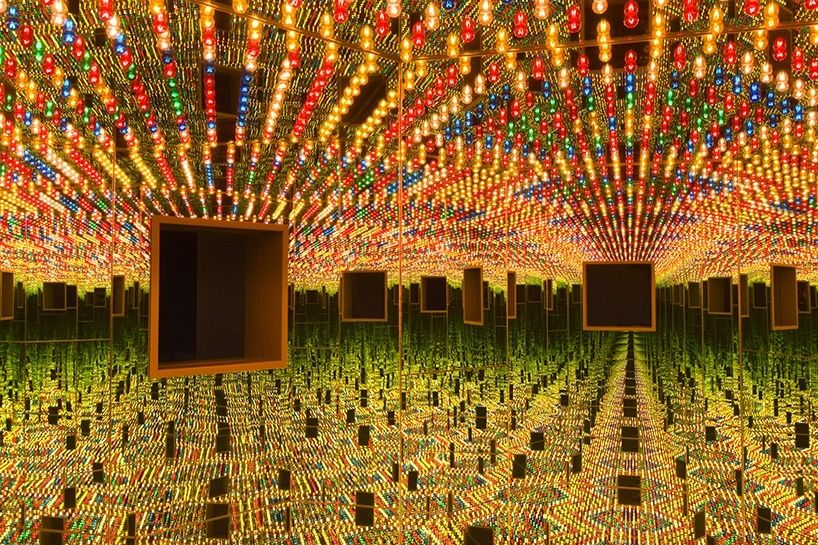
The psychological effect depends on an unstable oscillation between wonder and self-awareness. The visitor may first look outward into an infinite field, then notice a reflected body interrupting the illusion. That body is not simply an external observer appearing in the image. It is an active coordinate within the room”s visual mathematics. Every movement changes the composition, while every pause confirms that the apparent infinity is conditional upon a finite presence. The work turns self-observation into spatial integration.
Eva Schlegel”s reflective labyrinths pursue a related problem through obstruction and feedback. In a mirror labyrinth, the visitor does not receive a single panoramic revelation. Instead, fragments of passage, reflection, and partial visibility create a sequence of provisional decisions. Because the supplied documentation for Untitled (mirror labyrinth), presented at Art Basel Unlimited in 2024, provides limited technical detail, the work should be approached cautiously rather than assigned unsupported materials or effects. Its conceptual importance nevertheless lies in the broader labyrinthine operation: reflection can make orientation recursive, requiring the visitor to interpret the environment while physically producing its changing image.
- First phase: visual expansion dislodges the expected limits of the room.
- Second phase: self-recognition interrupts the fantasy of disembodied infinity.
- Third phase: repeated reflections fold the visitor into the work”s spatial grammar.
- Final condition: orientation becomes provisional, negotiated through movement rather than assumed from a fixed viewpoint.
The physiological consequences of visual self-location are more complex than a simple feeling of vertigo. Balance, vision, proprioception, and expectation cooperate to tell the body where it is. When reflective surfaces multiply cues without supplying a stable anchor, that cooperation becomes effortful. Cognitive research concerning sensory integration and enclosed environments can be consulted through research indexed by PubMed Central, although the available page reference does not itself provide the article”s substantive findings. The critical point remains clear: mirrored immersion does not erase the body. It makes the body newly conspicuous as the unstable source of spatial information.
The Moving Image and Bodily Discipline
The moving image entered installation art by leaving the monitor behind. Rather than presenting a self-contained rectangle, screen architecture distributes image, sound, and duration across an environment. Frank Gillette and Ira Schneider”s Wipe Cycle of 1969 offers an early model. Its nine monitors combined live feedback, prerecorded material, television broadcasts, delays, and periodic wipe cycles. The central screen could place the viewer”s live image within a larger circuit, while surrounding screens circulated other visual information. Participation was therefore not an absence of structure. Cameras, delays, image inversion, and monitor placement organized the body with considerable precision.
This is where phenomenology becomes essential. A moving-image enclosure does not merely ask what the spectator sees; it asks how attention is captured, redirected, delayed, and physically staged. Illuminated motion has an involuntary force. A moving screen can seize the gaze before interpretation begins, while darkness can limit peripheral awareness and make the illuminated image feel architecturally dominant. Bruce Nauman”s video corridors sharpen the issue by demonstrating that participation may be highly constrained. Entering the work can mean entering a choreography of predetermined distances, angles, and failed attempts to locate oneself within the image.
Site-specific projection can also impose bodily discipline without relying on a narrow corridor. The Vancouver Art Gallery”s 2015 exhibition Beyond the Trees paired Emily Carr”s landscapes with digitally animated environments by WALLPAPERS. The collective created one monumental, outward-looking environment and another more confined, intimate space, using computer-generated patterns, movement, and projections in response to the gallery architecture. The contrast showed how nature can be experienced through both physical imagery and designed virtual systems. A forest is not only represented; it is paced, framed, enlarged, and made navigable through exhibition decisions.
- Capture attention: moving light, sound, or live feedback establishes the first point of sensory command.
- Distribute the gaze: multiple screens or projections prevent a single stable viewpoint and encourage scanning.
- Sequence movement: corridors, thresholds, surfaces, and changes in illumination determine when the body slows, turns, or stops.
- Expose the apparatus: delays, reflections, seams, and technological interruptions reveal that immersion is constructed rather than natural.
Tactile materials intensify this choreography. A rough wall, yielding floor, hanging membrane, or compressed passage can make movement conscious at the same moment that projected imagery encourages visual transport. The resulting spectator is neither fully liberated nor simply controlled. The body follows cues, resists cues, and occasionally finds gaps in the intended sequence. Total environments are most compelling when they acknowledge this negotiation, allowing architectural discipline to become perceptible without reducing the visitor to a passive subject.
The Enduring Horizon of Inhabited Art
Total environments transform art by making architecture, sensation, and psychology inseparable. Schwitters converted domestic accumulation into a spatial organism; Iglesias complicates the border between constructed form and living growth; Kusama turns reflection into recursive infinity; moving-image installations distribute attention through cameras, screens, projection, and time. Across these practices, immersion is not an ornamental increase in spectacle. It is a change in the artwork”s ontology. The work exists through the encounter between designed conditions and a moving body.
This is why total environments continue to reshape museums, galleries, public commissions, and digital-art venues. They demand new approaches to access, pacing, conservation, documentation, and interpretation. They also force institutions to confront the difference between an environment that genuinely reorganizes perception and one that merely offers an attractive image for social circulation. The viewer leaves neither unchanged nor external. Once the body has crossed the threshold, chosen a route, altered a reflection, completed a feedback loop, or measured a wall through touch and balance, it has become part of the work”s architecture. The frame has not disappeared; it has expanded until the act of inhabiting becomes the primary medium.