
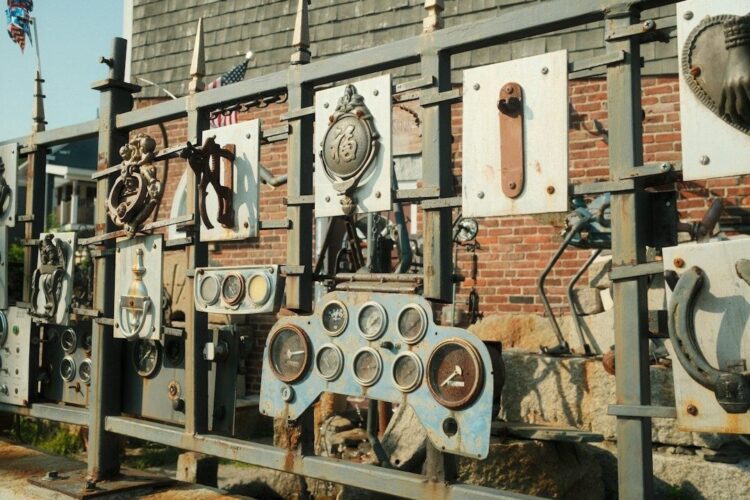
The Alchemy of Discarded Matter
Industrial assemblage begins where conventional sculpture often ends: in the bin, the scrapyard, the demolished factory, and the anonymous edge of the city. Its materials may include bent sheet metal, worn machine housings, corroded fasteners, broken tools, wire, plastic components, packaging fragments, and domestic objects stripped of their original usefulness. Yet assemblage is not simply the display of refuse. It is a deliberate system of selection, alteration, joining, and framing through which discarded matter acquires a new social and visual charge. A rusted gear remains evidence of mechanical labor, but within a sculpture it can also become a wheel, a wound, an eye, or a fragment of an extinct industrial order.
That transformation carries a long-standing tension between the pristine materials traditionally associated with fine art and the abrasive reality of mechanical waste. Marble, bronze, and carefully prepared wood imply durability, mastery, and cultural prestige. Industrial detritus brings contamination, failure, mass production, and obsolescence into the gallery. Its scratches and stains resist idealization. The material arrives already marked by use, and those marks become part of the work”s argument. What appears to be physical debris is therefore also historical evidence, a tactile record of labor, consumption, extraction, and abandonment. In industrial assemblage, waste does not disappear into a clean aesthetic. It returns as an urgent cultural witness.

Roots of Rupture in Cubist Collage and Dada Revolt
The modern history of assemblage cannot be separated from the radical break made by Cubist collage. When artists introduced newspaper, wallpaper, labels, faux wood grain, and other non-art materials into pictorial space, representation ceased to be a sealed illusion. The surface became a site where the real world could intrude. A scrap of printed language could function simultaneously as image, object, and cultural signal. This collapse of categories opened the door to three-dimensional practices in which the artwork no longer depicted an object but physically incorporated objects.
Dada intensified that rupture during World War I. Emerging in Zürich amid disgust with nationalism, bourgeois respectability, and the rhetoric that had helped legitimize mass violence, Dada treated artistic convention as another system requiring sabotage. Readymades, chance collages, photomontage, performance, nonsense poetry, and assemblage all attacked the assumption that art depended on noble materials or virtuosic handwork. Marcel Duchamp”s readymades shifted attention toward selection and designation, while artists such as Hannah Höch used fractured images to expose political manipulation, sexism, and the unstable machinery of modern society. A useful account of this wartime revolt appears in the Dada Movement Overview and Key Ideas.
The crucial development was a movement from passive representation toward aggressive material confrontation. An industrial fragment does not merely symbolize a factory; it carries the factory”s physical consequences. It can be heavy, sharp, oily, corroded, or structurally compromised. That directness made found-object art especially effective as an anti-bourgeois language. Its materials violated the expected cleanliness of the gallery, while its transformations questioned who has the authority to define art, value, and cultural permanence.
- Collage disrupted the unity of the pictorial surface by inserting fragments from everyday life.
- The readymade challenged the belief that artistic value depends primarily on fabrication.
- Assemblage expanded the argument into physical space, making mass, texture, and instability part of the work.
- Dada performance and photomontage connected material disruption to political and social critique.
Defining the Medium through Institutional Shockwaves
Assemblage became more legible as a distinct field when the Museum of Modern Art presented The Art of Assemblage in 1961, curated by William Seitz. The exhibition helped popularize the term and framed assemblage as composite art built through juxtaposition. Rather than demanding a single technique, it gathered practices that combined found objects and everyday materials while collapsing boundaries among painting, sculpture, architecture, and ordinary life. The institutional setting was significant: materials associated with streets, workshops, domestic interiors, and commercial production entered a museum traditionally identified with modernist innovation.
The category remained deliberately broad. Synthetic plastics could sit beside scrap iron, salvaged furniture, household relics, packaging, worn textiles, and mechanically produced components. Some artists refined discarded materials into controlled compositions; others preserved their fragility, age, and apparent lack of value. The result was never a single look. It was a method of placing unlike things into a charged relationship. Major historical accounts of the medium, including this overview of assemblage as an art form, emphasize that the genre is defined less by a specific material than by the intellectual and physical force of juxtaposition.
| Material register | Typical visual effect | Critical possibility |
|---|---|---|
| Scrap iron and steel | Weight, abrasion, rust, industrial severity | Labor, infrastructure, militarization, obsolescence |
| Plastic and synthetic components | Artificial color, repetition, brittle surfaces | Mass consumption, disposability, petrochemical culture |
| Domestic relics | Intimacy, recognition, nostalgia | Private memory, social class, changing habits |
| Packaging and labels | Graphic interruption, commercial immediacy | Brand identity, desire, advertising, waste |
Mechanical Craftsmanship and the Physics of Rust
Industrial assemblage may look spontaneous, but successful work depends on rigorous mechanical thinking. The artist must understand load, leverage, center of gravity, stress points, and the behavior of unlike materials. A visually compelling fragment can be useless if its weight pulls the composition forward or if a brittle joint cannot withstand handling. Structural joinery may involve bolts, rivets, threaded rods, clamps, brackets, or other cold connections. Welding can produce a more permanent union, but it also alters the surfaces being preserved and introduces heat, distortion, fumes, and fire risk. The choice of connection is therefore both an engineering decision and an aesthetic one.
Rust complicates that decision. Oxidation can produce extraordinary color and texture, but it can also weaken metal, shed particulate, stain neighboring materials, and conceal dangerously thin sections. Sharp edges, residual oils, lead-based coatings, solvents, and unknown industrial residues require serious studio protocols. Surface preservation may involve gentle cleaning, mechanical stabilization, clear coatings, waxes, or carefully controlled removal of loose corrosion. The objective is not to sterilize the object. Over-cleaning can erase the very history that gives the fragment meaning. Stabilization should preserve evidence while preventing the work from continuing to collapse.
A disciplined workflow turns hazardous scrap into a balanced composition:
- Document the source material. Photograph each object, record its condition, and note uncertain coatings, residues, or structural weaknesses before cutting or cleaning.
- Sort by structural role. Separate potential bases, supports, connectors, shells, accents, and counterweights. Not every dramatic fragment should become the focal point.
- Test the composition dry. Use temporary clamps, blocks, or supports to study silhouette, balance, negative space, and the direction of visual weight.
- Choose the least destructive connection. Bolts and brackets preserve reversibility, while welding offers strength but may erase patina or alter the metal”s temper.
- Address the surface deliberately. Remove only unstable contamination, stabilize active corrosion, and distinguish between valued patina and material failure.
- Stress-test the sculpture. Check joints, tipping points, sharp projections, and transport vulnerabilities before the work enters a public setting.
Subverting the Machine Age into Cultural Critique
Assemblage turns the machine age against itself. Industrial systems promise efficiency, standardization, and continuous improvement, yet they also generate enormous quantities of planned obsolescence. A component becomes obsolete not necessarily because it has ceased to function, but because a newer model, market strategy, or supply chain has displaced it. When such a component enters a sculpture, its former role remains legible while its economic destiny is interrupted. The artwork refuses the logic that usefulness is the only measure of value.
This critique becomes sharper when artists work with municipal waste and urban residue. A trash container, demolition fragment, discarded mannequin, plastic wrapper, or broken appliance can carry several histories at once: the history of manufacture, the labor of distribution, the habits of consumption, and the civic systems designed to remove evidence of excess. Jim Condron”s assemblage practice, discussed in the Delaware Contemporary”s exhibition Trash Talk, combined scrap metal and plastic with materials such as wood, foam, cement, clothing, mannequins, solvents, and trash cans. The resulting works treated preservation itself as an artistic act, giving discarded and ephemeral things renewed purpose and permanence.
The most powerful industrial assemblages also preserve the memory of human labor. A machine part is not culturally neutral. It may have passed through the hands of machinists, maintenance workers, warehouse staff, demolition crews, cleaners, and repair technicians. Its dents and improvised repairs can reveal practical intelligence that official industrial histories often overlook. By retaining wear rather than disguising it, the sculpture grants visibility to labor embedded in anonymous objects. This does not romanticize industrial damage. Instead, it asks who benefited from the system, who maintained it, and who inherited its residue.
- Obsolescence becomes visible when a once-functional component is preserved after its commercial life has ended.
- Urban excess becomes tactile when municipal waste is reorganized into a body, monument, or unstable machine.
- Labor history survives materially through dents, repairs, abrasion, and residues left by use.
- Consumer identity is exposed when branded or standardized objects lose their original context and enter a new symbolic system.
Reimagining Future Ruins in the Modern Studio
Industrial assemblage remains vital because it offers a form of attention that digital culture often suppresses. Screens can reproduce the image of a corroded gear, but they cannot supply its weight, smell, resistance, or danger. Tactile sculpture restores physical consequence to a culture increasingly organized around immaterial transactions and frictionless interfaces. The assembled object demands proximity. It occupies space, casts a shadow, threatens imbalance, and makes the viewer conscious of the body”s relationship to matter.
For contemporary creators, the strongest practice combines imaginative risk with practical discipline. Source materials through documented salvage, reuse existing industrial networks where possible, and keep records of provenance without pretending that every fragment has a fully recoverable story. Separate stable patina from active deterioration, wear appropriate protective equipment, and design joins that can be inspected and repaired. Curate the final arrangement as carefully as the material itself. A successful work does not merely gather junk; it establishes a hierarchy of forces, memories, textures, and absences. The discarded object becomes a raw monument of current civilization, not because waste is automatically profound, but because deliberate form can make its hidden histories impossible to ignore.